Buenos Aires, Argentina, 2019

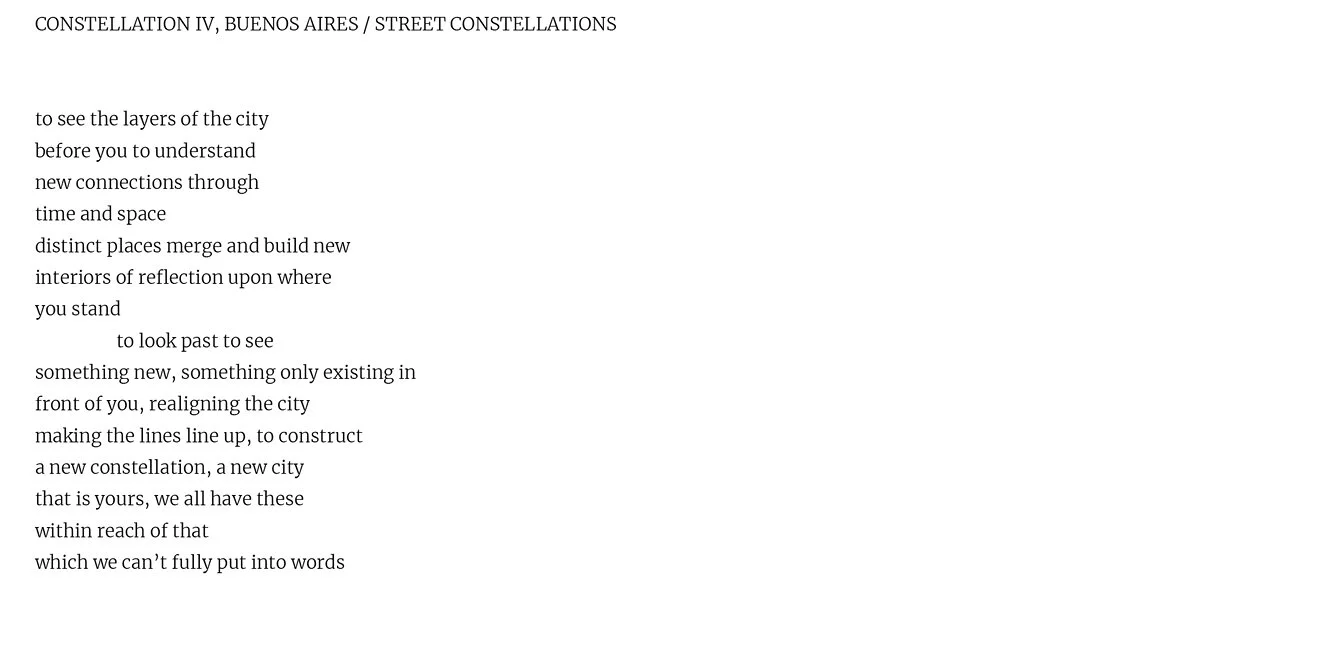
STREET CONSTELLATIONS
2019-ONGOING // 120MM MULTIPLE EXPOSURE // BUENOS AIRES [ARG] // PARIS [F] // NYC [USA] // TAIPEI [TW] // MEXICO CITY [MX] // NEW ORLEANS [USA] // SAU PAULO [BRA] // ATLANTA [USA]
What do we see when we look at the city? What parts spring towards us, what might we miss because we see too much, that we can’t cut away and focus on. The camera can block out the surroundings and allow you to see. This is what I utilize to create new compositions that engage audiences in conversations about cities.
In conversation with writer and disability activist Georgina Kleege, I came to understand this method as more than a technical experiment—it is a direct expression of my Autistic perception. By layering and reframing urban space, I am not only articulating my own way of seeing but also embedding a disabled perspective within architectural discourse. In doing so, this process challenges dominant spatial paradigms and offers new trajectories for the architectural canon.
The process of how these works are made, exposed using only the camera, is important to the final expression of the work; a description can be found here.
當我們觀看城市時,我們究竟看見了什麼?哪些部分會主動向我們浮現?又有哪些可能因為資訊過多而被忽略,使我們無法抽離、無法聚焦?相機能夠阻隔周遭的干擾,讓觀看成為可能。我正是運用這一點,創作出新的構圖形式,邀請觀眾進入關於城市的對話。
在與作家暨身心障礙行動者 Georgina Kleege 的對談中,我逐漸理解這種方法不僅是一項技術性的實驗——它同時也是我自閉式感知(Autistic perception)的直接展現。透過對城市空間的疊加與重新取景,我不僅表述自身的觀看方式,也將身心障礙的視角嵌入建築論述之中。這一過程對主流的空間典範提出挑戰,並為建築正典開啟新的發展路徑。
這些作品的製作過程——僅透過相機進行曝光——對作品最終的表現至關重要;相關的製作說明可於此處查閱。
Midtown East, Manhattan, New York City, USA, 2021
Wanhua, Taipei, Taiwan, 2024
Shilin, Taipei, Taiwan, 2023
Juarez, Mexico City, Mexico, 2024
Bed-Stuy, Brooklyn, New York City, USA, 2023
Chicago, USA, 2022
Marigny, New Orleans, USA, 2021
SESC Pompeia, Sau Paulo, Brazil, 2023
Downtown Atlanta, USA, 2021
Paris, France, 2019
Buenos Aires, Argentina, 2018