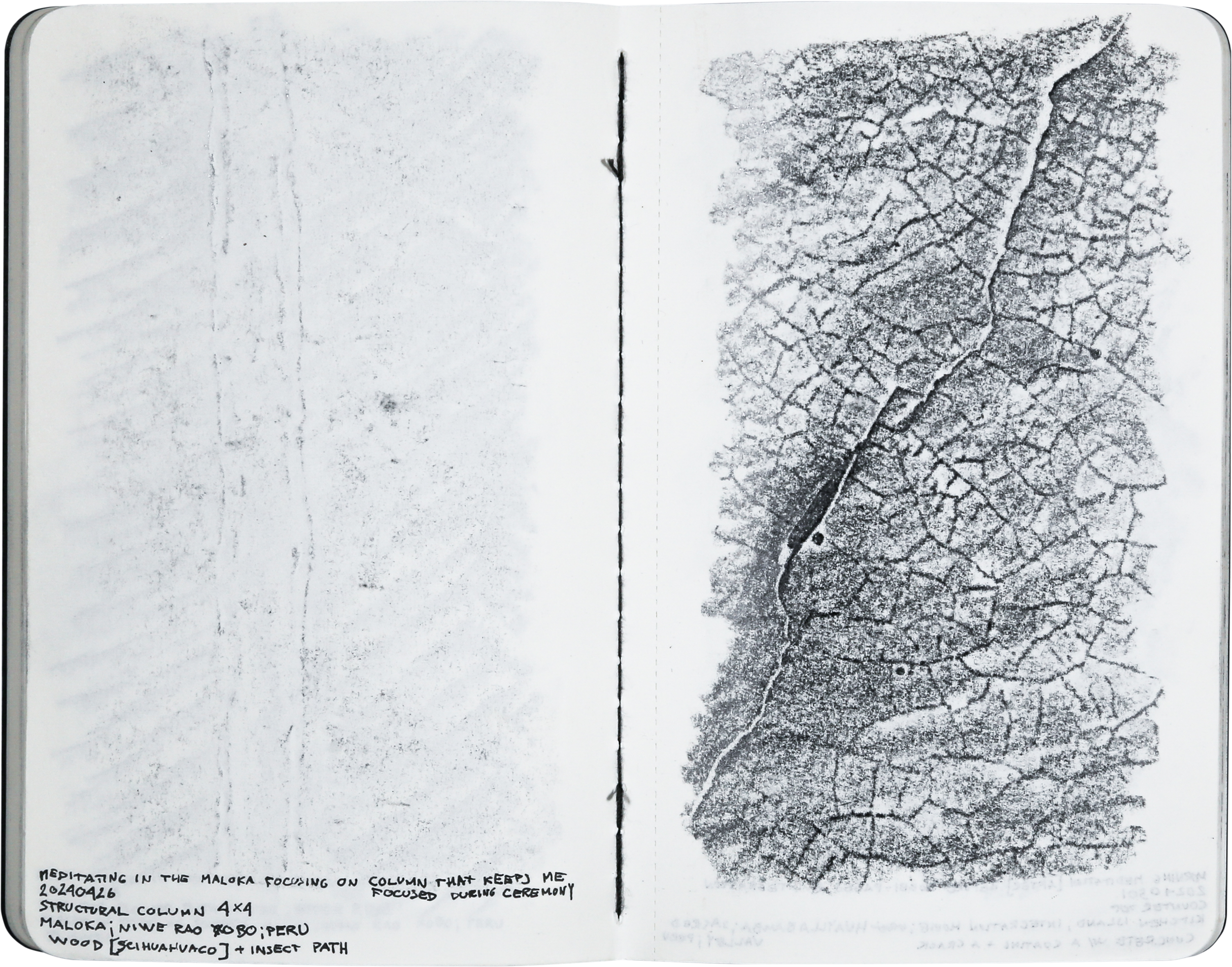
after morning meditation, before bobbi-pages @ integration
20240501
counter top
kitchen island; integration home; huayllabamba; sacred valley; peru
concrete w/ a coating + a crack
TEXTURES
2012-Ongoing // Wherever I am
We come into contact with our environments every day, though we often shield ourselves from them with clothes, shoes, and gloves. I’ve always been extremely sensitive to the textures around me. Later, I learned that this was likely an early sign of my autism that I didn’t understand, sensitive to how clothing felt or tags or what sitting on a bench felt like, or lying in the grass, walking barefoot.
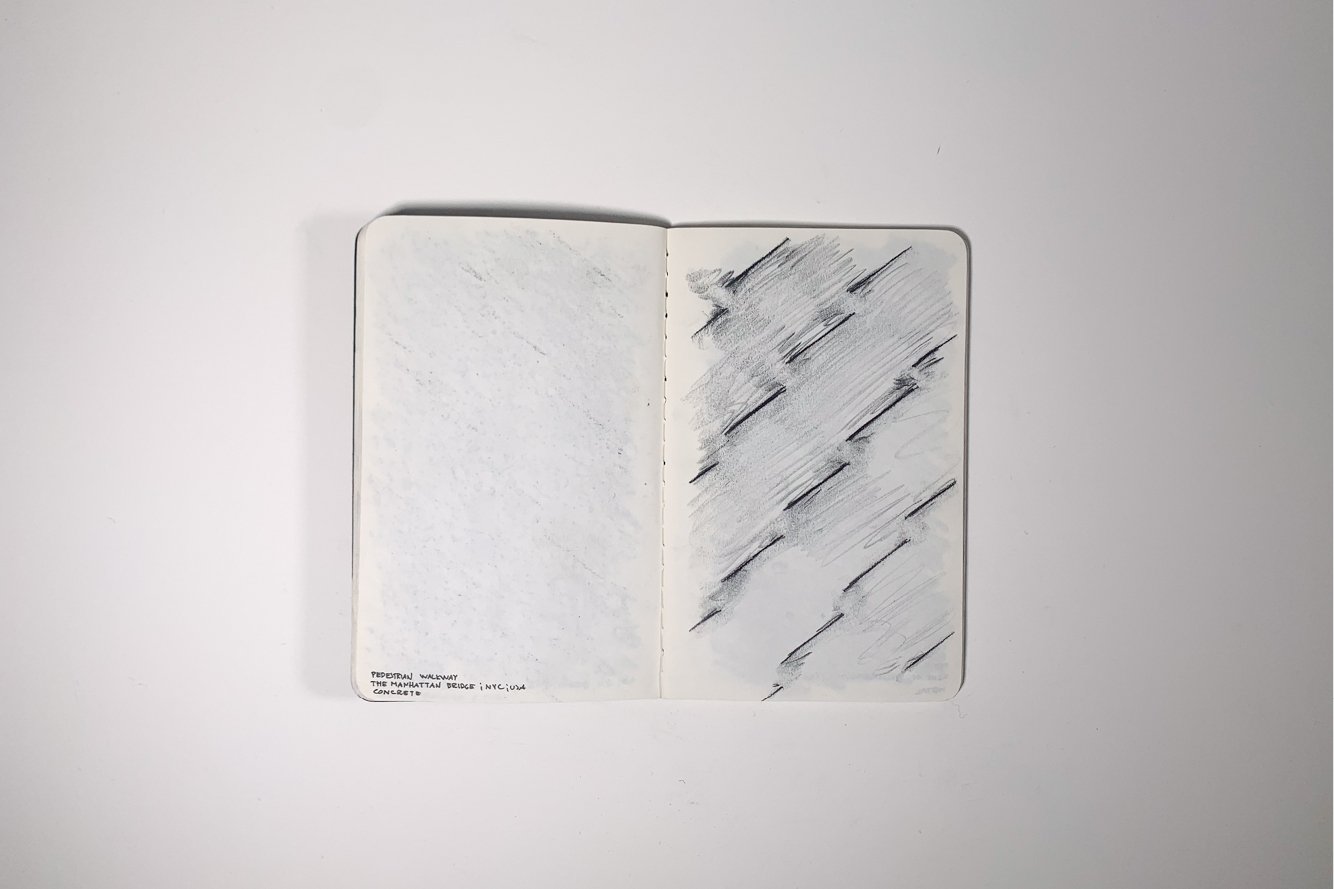
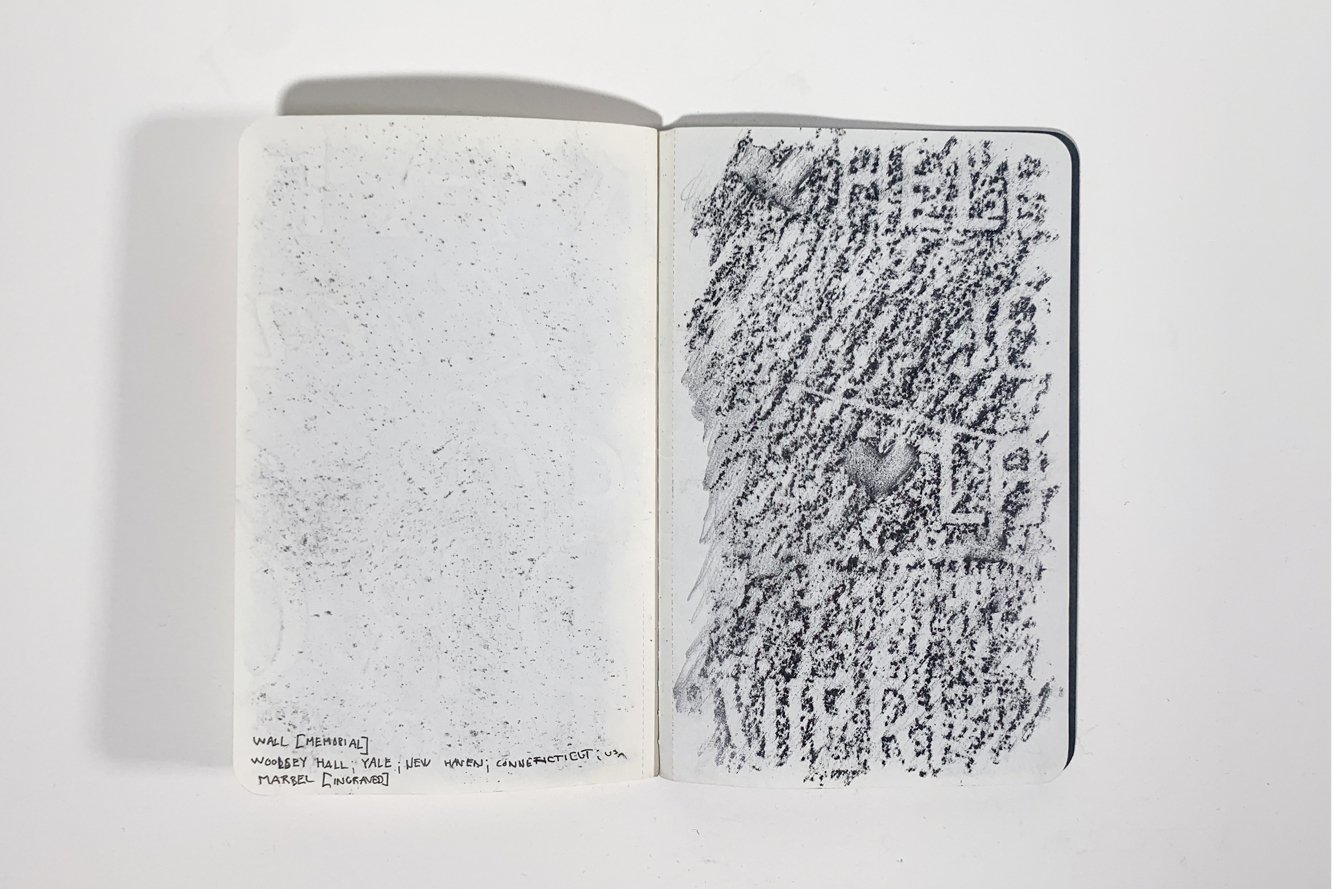
This led me, in 2012, to take a small Moleskine notebook [3.5” x 5.5”] to the wall of my then live/work studio in Copenhagen and rub the paper with a ¼” carbon pencil, to see, to understand the texture of the wall around me. I labeled the backside of the paper: WALL / MY ROOM / AMAGER STRANDVEJ 122 / PEELING PLASTER.
This would be the first of numerous textures that I have since rubbed in all places and spaces I have found myself, from important architectural spaces, such as Luis Barragán’s studio wall, to the mundane, a Dunkin' Donuts tray in Berlin, to the personal, a family chair armrest. Continuously collecting the memory of touch, of the spaces I move through.
It shows us the world, the cuts and edges we otherwise can only perceive with our touch, but so often tend to ignore. It recombines the touch with sight, something that Traditional Chinese might always have known, since the way to write ‘to see’ 看 [kan] is a combination of the character for ‘hand’ 手[shou] and eye 目[mu], meaning that to see is the touch of the eye.
“The rubbing, the act of using charcoal to catch the indentations of a field, to move the field into new horizons, is an intensive act, not an extensive one. What is mobilized is not the form but the activity of shaping.” - Erin Manning, The Being of Relation.
The collection is currently as of June 2026, working on book 47. Books 5 & 7 have gone missing, and rather than replacing them, I like to think of them as having a life on their own. I remember that book 7 only had about 4 textures when it disappeared in a fog of mopet smoke in the Copenhagen NorthWest. And Book 17, I have gifted and don’t know what has happened to it since then.
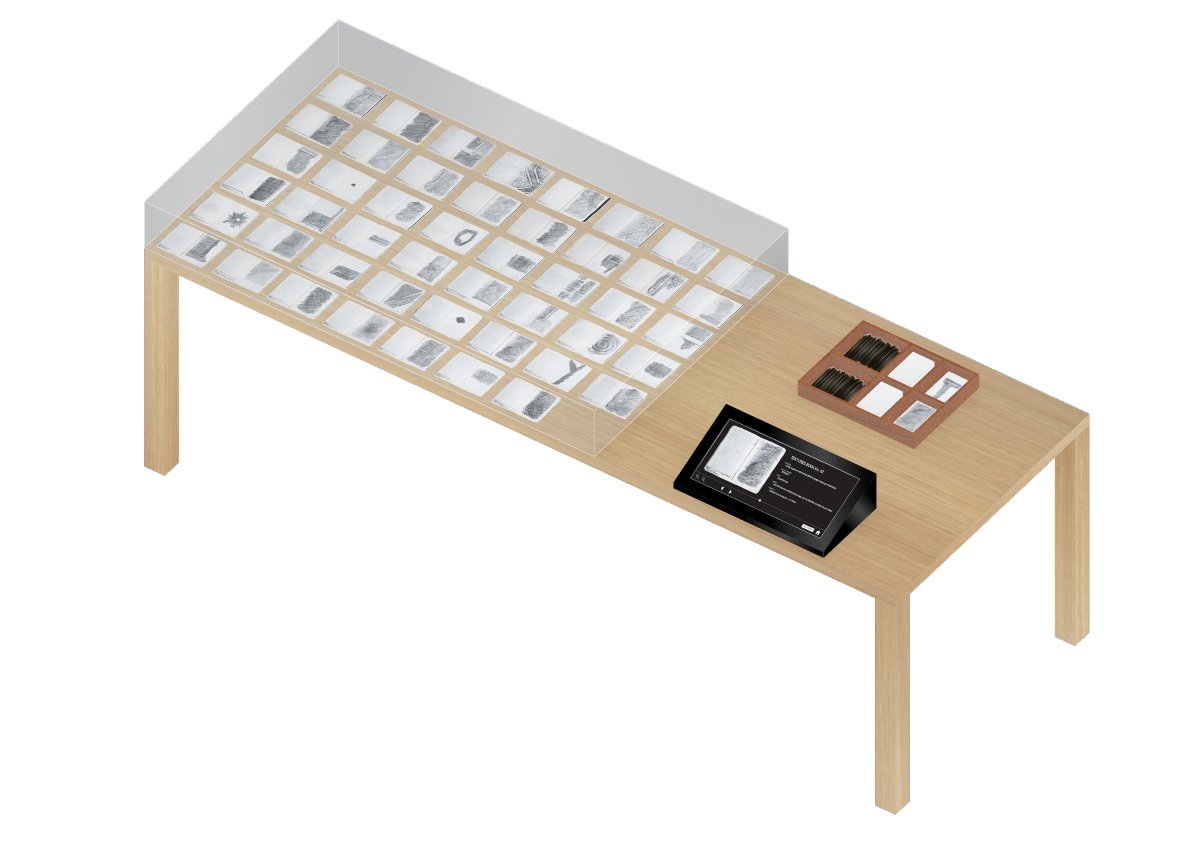
AXO drawing that shows how the textures can be displayed in an exhibition. All texture books are under protective glass and opened. Each day, the staff can flip the pages to show new textures. On the right side of the table is a digital screen that contains digital photographs of all textures from all books, allowing the viewer to explore all the books. Across from the screen is a wooden box containing pencils and blank paper, so the audience can create their own textures. The box also contains a raised line drawing for feeling some of the textures.
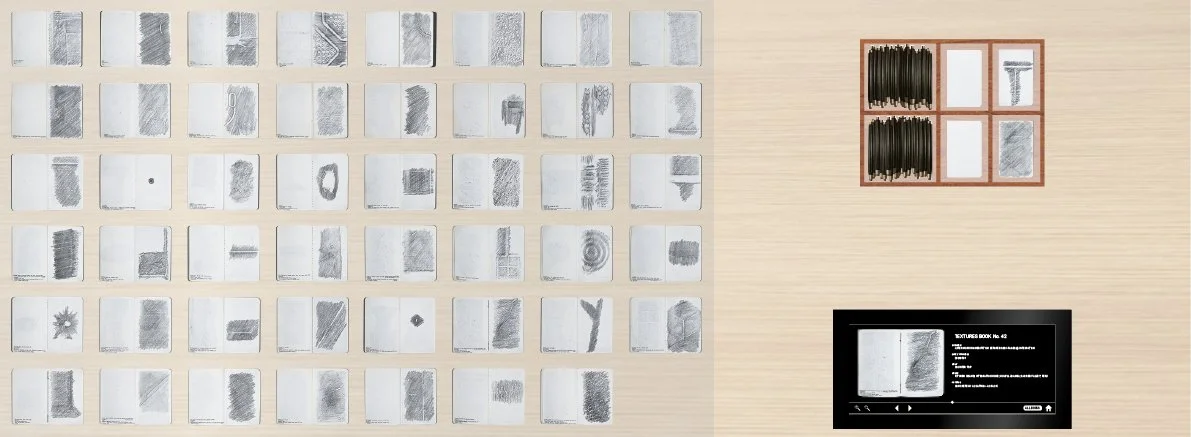
Plan of the table.

A diagram of the digital screen, where audiences can digitally flip through photos of the textures from all the books. Below are three different ways into the books, either chronological by book number, by geographical location, or by material. Next to the image, a text explains: the situation, the date, what it’s of, where it’s from, and the material.

A diagram that explains what the wooden box contains: pencils, blank paper, and raised line drawings of some textures, along with a space to collect textures made by the audience.

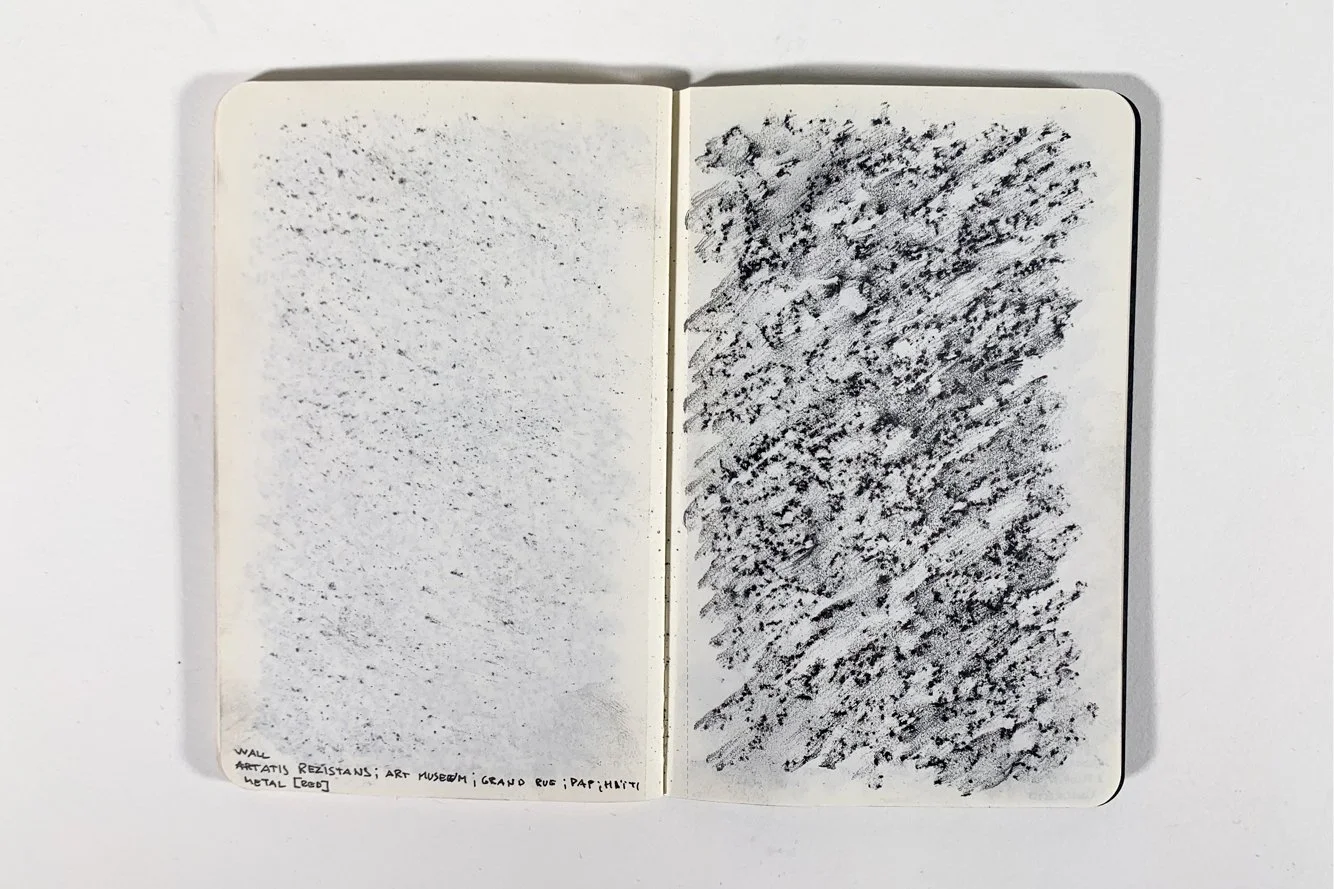
Wall
My Room
Amager Strandvej 122
Peeling Plaster

Collections of floors from distinct notebooks
Floor [Showing Celeaur]
2. Floor Studio of Celeur; One Street Over From Grand rue PaP; Haïti
Concrete

20190428
Door
Brother & Sister [Entrance]; Adams Morgan; 1770 Euclid St NW Washington DC; USA
Copper
20190428
Chair; Side Ribbons To Hold Fabric
Off The Record; The Hay-Adams; 16th NW; Washington DC; USA
Brass Ribbons + Veleur Fabric; Red

20160804
Wall
Luis Barragán Studio: DF” Mex

Handrail
Scarpa’s Oliveti Shop; Venice
Wood

A close-up photo of the backside of a page with a carbon rubbing on it. The rubbing has made an imprint on the page. Text on the back describes the rubbing, date, item, place, and material. This rubbing is from Sunnyside, Queens.

Tray
Donkin’ Donuts; Berlin
Plastic

Manhole Covers
Fence
Kent Av; Williamsburg NYC; USA
Metal

Backrest
Bar; CPH
Woodbars Covered With A Thick Blanket
Sidewalk
Elm & Main St; Winsted CT; USA
Bricks [Engraved]
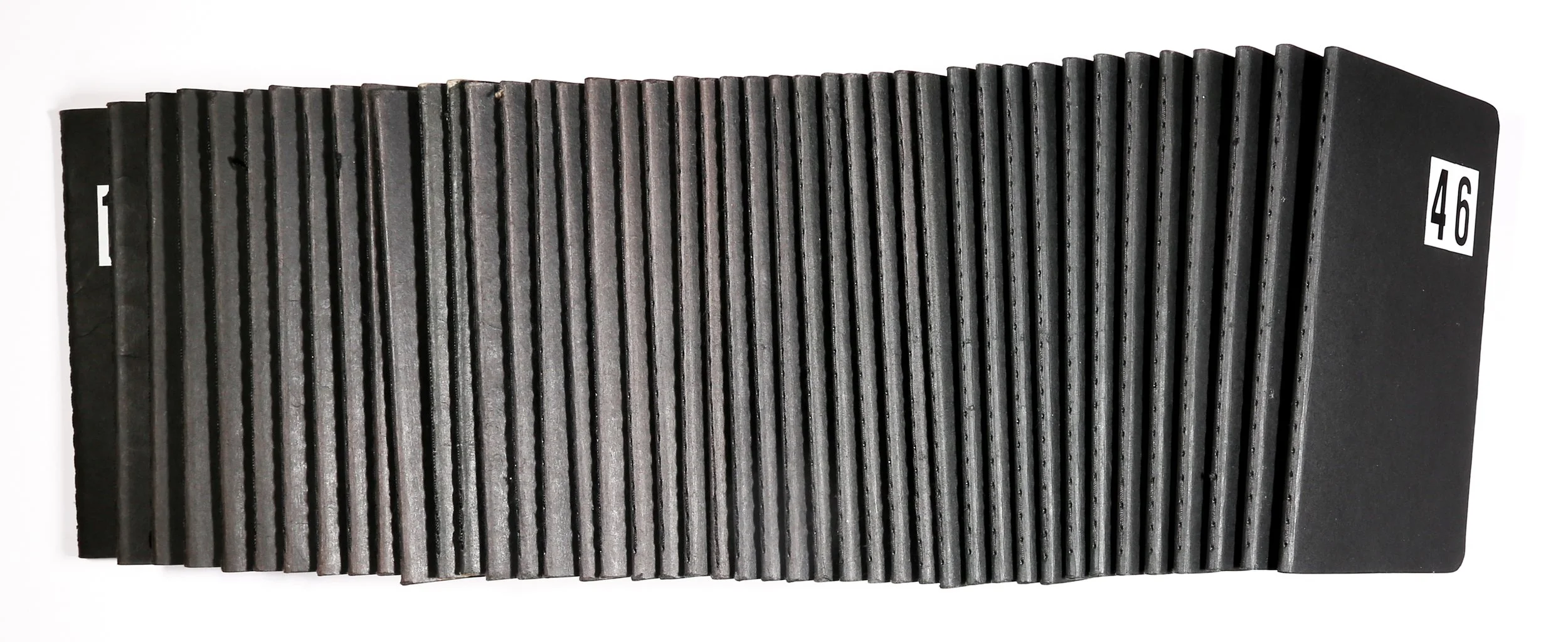
Photograph of the textures notebooks, from 1-46.
